CEO Update: How can we get to zero in Timber Creek?

Mental Health Australia Director of External Relations Lachlan Searle recently had the opportunity to join the R U OK? Trust the Signs Tour, driving some 4,500km from Darwin to Perth. Lach’s guest blog below is a clear example of the challenges we all face in advocating for, and delivering, improved services and outreach across the country… especially if we are to ‘get to zero’.
How can we get to zero in Timber Creek?
In recent months Prime Minister Scott Morrison and Minster for Health Greg Hunt have talked openly about suicide prevention and that they are ‘working towards a zero suicide goal’… and what a great aspiration for the entire nation to have.
So when I joined the R U OK? convoy and stopped off in Timber Creek last week, I started to ask myself the same questions. How can we prevent suicide in this small community? What can we do to help? What are the answers? What needs to change? What will work? What will stop this epidemic? What is culturally appropriate? Why is it happening? Why?
Three hundred people live in Timber Creek in the Northern Territory. It’s an isolated little ‘highway’ town of just a couple of streets, nestled on the Victoria River some 600km from Darwin.
There’s a police station, a school, a modest medical clinic, a roadhouse which doubles as a caravan park for the stream of travellers heading West to Broome, or North to Darwin, and a smattering of houses, and sheds that also house people.
Beyond the tourism and travellers stopping off for a night, or maybe two, to take in the crocodile sightings or a spot of fishing for Barramundi, there’s a serious issue in Timber Creek. A community struggling with the compounding effects and impact of multiple youth suicides.
When the R U OK? Trust the Signs Tour arrived in Timber Creek it looked like nothing more than a petrol station and a caravan park full of people ‘doing a lap’ as they say on the road.
Scratch the surface and when you looked beyond the bowser there was a lot more going on, as we soon found out on meeting the local school principal, who was quick to highlight the serious issue of youth suicide in this community. A school community that is struggling, after four deaths to suicide already this year. A school community with less than 50 students aged five to 18.
That’s right, the numbers are real and when the R U OK? crew stopped in the next morning to talk to the students, it was a powerful message to deliver and one in which every student could potentially relate to.
Enter Kevin Heath, an R U OK? Ambassador and Butchulla man from K’gari (Fraser Island) who was able to sit down with the kids and connect instantly. He talked about how important it is to talk, but also to listen and to ask for help if and when you need it. To look for signs in friends and family, and ask them that simple question ‘are you ok?’
Kev’s impromptu chat and storytelling of his own journey, artistically displayed on his many tattoos, held the kids attention for twenty minutes or more. They were listening and they were looking up to a young role model with a message of hope and healing.
I firmly believe that if Kev could have set up camp in Timber Creek, and stayed there for a year or more, his positive attitude and ability to be role model to young Indigenous kids would have helped that little community ‘get to zero’.
But alas, his skills and ability are needed back home in his work for NSW Health in the Eastern Suburbs of Sydney, a much bigger community, but a community also aspiring to ‘get to zero’ themselves.
Kind regards,
Lach Searle
Director, External Relations
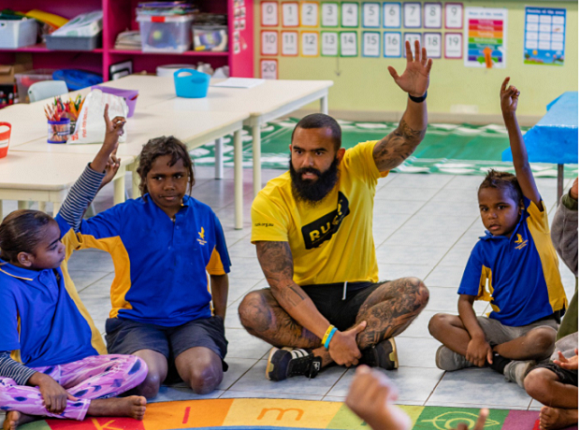
Photo: Courtesy of Ben Houston Photography and R U OK?
NDIS Optimising Psychosocial Support working group
In 2018, Mental Health Australia undertook a project, funded by eight project partners, to bring together, for the first time, the service level data from community based mental health programs to present a picture of how people with psychosocial disability were supported in ‘pre-NDIS’ programs. The project provides a rich and valuable evidence base to augment and support the NDIA’s work to deliver the most appropriate support to NDIS participants with psychosocial disability. Information about the NDIS Optimising Psychosocial Support Project, including the final project report, can be found on the Mental Health Australia website.
This week, Mental Health Australia and the National Disability Insurance Agency collaborated to bring together a time limited working group to consider the project outcomes. The working group includes mental health consumer and carer representation alongside service providers who have day-to-day experience delivering psychosocial support through the NDIS and NDIA officials. The group aims to compare and contrast the evidence presented in the Optimising Psychosocial Supports project with the National Disability Insurance Agency’s evidence on psychosocial services under the National Disability Insurance Scheme (NDIS) in order to help to build an evidence-based picture to help inform the design of future packages of support.
Ensuring the Sustainability of the Australian Health System - Report
Australia’s Health 2040, a cross-disciplinary taskforce (of which I am a member) facilitated by the independent policy institute Global Access Partners, has released a report outlining 19 reform options for the Australian health system to ensure a more sustainable future.
The reforms aim to improve everyone’s quality of life and the equity of health outcomes as well as balancing the system’s cost-effectiveness with the safety, quality and sustainability of service provision.
National Press Club Mental Health Forum: How To Fix Australia's Crisis
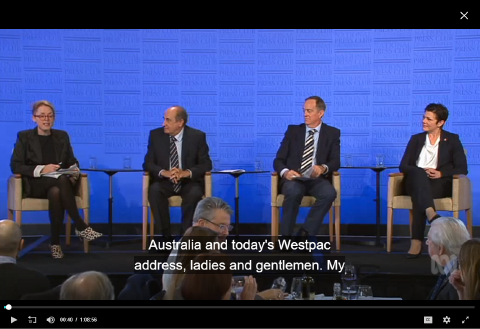
On Wednesday myself and staff from Mental Health Australia went to the National Press Club where Beyond Blue CEO Georgie Harman, Director of ConNetica John Mendoza & Head of ANU's Mental Health Research Centre Luis Salvador-Carulla discussed How To Fix Australia's Mental Health Crisis. It was an engaging and passionate discussion, with the consensus firmly landing on the need for the mental health system as a whole to be reformed, including by addressing the social determinants of health and much more. Each speaker presented detailed and cohesive suggestions for making this happen; the entire forum can be watched here.
|
|
|
|
|
|
|
On Monday, I will be meeting with Darren Black, CEO of OzHelp. On Tuesday, Harry Lovelock, Director of Policy and Projects will be meeting with Minister Ruston, as part of the National Disability and Carers Alliance. On Wednesday, I will be attending Minister Hunt’s National Press Club address, along with Mental Health Australia staff. Thursday, Mental Health Australia staff will be participating in Mindfulness Based Stress Reduction training, the first in a series of four. And on Friday, I am looking forward to participating in the launch of the Embrace Project in Melbourne. Embrace Multicultural Mental Health is run by Mental Health Australia and provides a national focus on mental health and suicide prevention for people from culturally and linguistically diverse (CALD) backgrounds. |
|
|

|
|
|
|
|
|
|


